165: Strengths vs Weaknesses

165: Strengths vs Weaknesses

SHOW DESCRIPTION

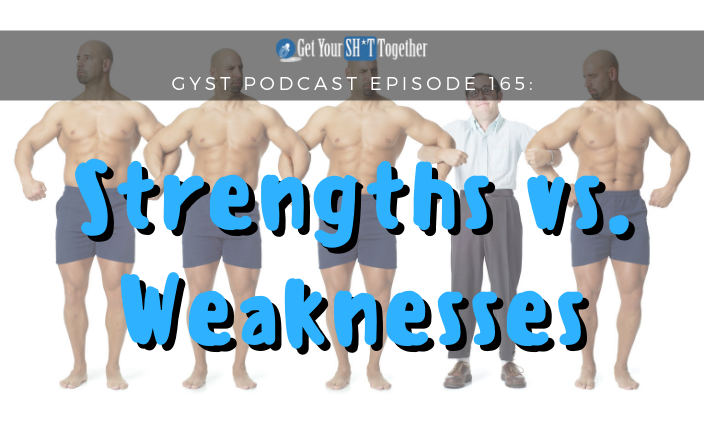
Everyone has their own strengths and weaknesses. Some people are good at one thing and not so good at another. You may be great at public speaking, but terrible at writing. You could be able to fix any technical problem in the IT world, but maybe you are not so great at working with other people. Which is more important; understanding a person’s strengths or their weaknesses?

Kevin and Kyle explore from differing perspectives. In this discussion, Kevin supports the idea that understanding a person’s weaknesses is more important. It gives you an understanding of what a person can’t do, and what they can work on to become stronger. In hiring, you want to know what a person can’t do. You don’t want a person who can’t read writing training journals. However, if this person is great at communicating ideas with a team, you might put them in an environment where their ideas and thoughts will build a stronger, more productive team. Some people are just not comfortable with doing certain tasks. A lack of confidence can be a weakness. With that knowledge, you can then take action to build up the confidence so that the weakness turns into a strength.

Kyle comes from the point that knowing a person’s strengths is more important. It is good to know where to start with a person to get the best productivity out of them from the start. It’s like building a home on a site where the house has already been torn down. If the foundation is already strong, you can continue to build the house on that foundation.

As a group, we understand that it is important to know both. Having a balanced understanding of what a person can and can’t do will inevitably lead you to stronger team dynamics. You will be able to shift people around to where they are most skillful and make plans to strengthen areas where they need the most help.

In our personal lives it is just as important. When you know your current limits, it makes it easier to make your plans to either strengthen your weak points or play off your strengths in any given situation. Knowing yourself is key to growing yourself.

 

164: Technology- Instrumental or Detrimental?

164: Technology- Instrumental or Detrimental?

164: Technology- Instrumental or Detrimental?

by Kevin Barquest, Kyle Reed, and Rohit Rohila

SHOW DESCRIPTION

Technology is a testament to how mankind has grown. Since the dawn of time we have been inventing things to make our lives easier; the wheel, the steam engine, telephones, computers, etc. We have technology that has made our lives so much better today than anytime in our entire history. However, is there a point when technology is a detriment to our lives and our growth?

For the most part, we do have easy access to information. We can look up information on anything we want right in the palm of our hands. Our cell phones are mobile computers that give us what we need; Navigation, reference material, news, recipes, and entertainment. There is a real problem with this easy access though. Everyone knows that it is easily accessible and fewer people know how to actually research information for themselves. If you ask a student in high school today to do a simple math problem without the use of their phone or a calculator, they would probably get a look that of a deer looking head on at a semi truck’s headlights. Ask a driver to go anywhere unfamiliar and take away their access to GPS units and they would be lost.

The problem with an abundance of technology is that we end up relying on it so much that we are invalid when it is taken away.

Family-time has also struggled. The TV or radio was something that the family used to gather around in the evenings. They would watch shows together, and in my case, would talk about our days during commercials. I always wanted a tv of my own in my bedroom and my parents always balked at the idea until I got into High School. Once I got my own TV I was able to watch shows in my room whenever I wanted as long as I had a TV cable or a VCR (Yeah…I’m old). Now everyone can stream on multiple devices anything they want to see. People go into other rooms or put on headphones and watch what they want. The social factor is now taken out of the picture.

From manual labor jobs, to Information Technology jobs our jobs have been made easier with technology. A draw back to this is the fact that as technology improves, our productivity increases and the fewer workers a business may need. We lose some jobs to technology. McDonalds is a prime example of this with their digital ordering system. People can now walk up to a digital display to build their order, or they can use an app on their phone. Now McDonalds needs fewer cashiers.

It is important to understand that technology is important to the improvement of our lives, but if we rely too heavily on it, we will end up hurting for it in the future.


163: Simple Things Every Team Needs To Succeed

163: Simple Things Every Team Needs To Succeed

163: Simple Things Every Team Needs to Succeed

by Kevin Barquest, Kyle Reed, and Rohit Rohila

SHOW DESCRIPTION

Teams are only as good as their individual parts allow them to be. I am not necessarily talking about the individual people, but the individual internal parts each member holds. These are things like belief, dedication, effort, trust, support, and accountability just to name a few. Without these things in place, the best rated leaders and team members in the world will fail.

Teams can make projects easier to complete, but only if the team shares the same vision. A few examples of good Teams with a shared vision are the ’85 Chicago Bears, the 2013 Seattle Seahawks or the 2016 Chicago Cubs. In the aforementioned cases, the Teams were united in their presentation of their goals, the work they needed to put in to get it done, and they believed in their vision. When they had those things in place some natural leaders stepped up and led the vision. They each held each other accountable, but the leader made sure the path ahead was clear.

A leader will tell their followers where to go, but a good leader will show their team the way to get there. A team with a singular vision will find it easier to follow a good leader because those leaders will offer encouragement that builds up both the top and the low performers. A Good Leader will inspire their team members on to better performance. This is true with all types of teams; whether sports, business, or whatever.

We all have had bad team experiences in our lives. Either the team wasn’t unified in their vision, or the leader didn’t promote a healthy competitive environment. If the leader is bad, the team will lose focus and stop believing in their vision. If the team stops believing in the vision, the leader will lose respect and control of the team. If you want a Team to be successful, you need to have a unified vision, accountability, trust, and leadership. If a single piece of that is missing, the team will eventually fail. If you are part of a bad team, find a way to bring in a shared vision. That will start the ball rolling in the right direction.


162: Habits of Average People

162: Habits of Average People

SHOW DESCRIPTION

There are several things that come to mind when I think of “Average Person.” Average people do not plan for the future, do not have assets, have lots of liabilities, spend more time in front of the television, and don’t read books. Investing in oneself is not something an Average Person does. So why do people live Average lives?

Many people don’t even realize that they are just “Average.” This is because we always think of ourselves as above average. We are more likely to look at someone else and judge them by their actions while we judge ourselves by our intentions. Maybe it is because we just can’t see that those people may have had good intentions as well. It could be that we don’t trust that everyone has as good of intentions as we have. This leads us to use excuses for why we aren’t successful. “I’m not that bad,” or “At least I don’t have his/her bad habits.”

Changing your life in drastic ways really doesn’t take huge life altering decisions. It can be something as simple as having a glass of water. For me, my go to drink used to be soda. I would drink half a 12 pack a day. I switched it to juices at first to get the sugar but cut back on the caffeine. Then I started drinking water at my desk at work throughout the day rather than juices. Now I am having water at work, at home, and whenever I go out to eat with my family. Simple small steps end with you on a totally different path than you began on. I have also done something similar with my eating habits. I started with switching up breakfast to include a salad instead of fast food. Now I am cooking more at home and cooking healthier foods. Instead of potato chips for snacks I am grabbing a bottle of water or an apple.

I may not see immediate changes in my size or health, but over time, if I look back, I am amazed at where I was vs. where I am now.

The Average person looks for excuses where the above average person accepts that it is no one else’s fault for where they are in life. It is easier to sit back ad blame circumstances and blame someone else for where you are in life. It means you don’t have to deal with the embarrassment of knowing you screwed up your own life. You don’t have to take ownership because you can just blame the government, your co-workers, your family, or insert your boogey man here.

If you don’t want to be average, it is simple. Don’t be average. Take ownership of your life. Don’t complain about something if you are not taking actions to change it. Don’t point fingers and say you are better than someone else. Focus on making good decisions and learning from the bad ones and you will not be an Average Person. You will not end up being a Basic Bitch.


161: Dangers of Personal Development

161: Dangers of Personal Development

SHOW DESCRIPTION

Our team is always talking about the benefits of personal development. However, there are some very real risks involved. Not that the steps you take to improve yourself involves risk to your physical health or anything like that. It is more the risk of having the wrong mindset and the problems that arise from that.

One of the biggest issues many of us may face when involved with personal development is going through depression. In personal development we are supposed to focus on growing into the best version of us that we can be. However, many of personal development ‘followers’ start comparing their lives to those of the people they want to be. The problem with this is we will always see the ‘ideal’ person as being better than us and we will never be good enough. Mainly, we are looking at the other person and saying the only reason we aren’t them is because we lack something. Then we end up giving up because we don’t have what that person has so why even try.

The point of personal development is not to make us into someone else or to become another person. It is to simply become the best ‘you’ that you can be. We can’t do that if we are looking at someone else saying we want to be them. It creates a false goal that doesn’t get us to where we need to go and makes it harder to reach our potential.

Personal Development is a lifelong process full of little successes and many failures. In many cases, you won’t be able to recognize the changes right away. However, if you look back after a long while you will see where your small changes in healthy decisions have completely changed the direction your life is going. It may not be recognizable at first glance, but as you improve and look back over your life, you will clearly see how you got to where you are. You will also find it much easier to see what changes you need to make to get where you want to go. The trick is to improve your life, not compare it to someone else’s. It is ok to have someone to look up to for inspiration or for advice, but don’t fall into the trap of comparing your life to theirs and giving up.


160: Understanding Your Past

160: Understanding Your Past

SHOW DESCRIPTION

As a team, we decided to go through one of Rohit’s worksheets to help him test out a piece of his upcoming 30-day Life Reset. After completing the worksheet, we decided that it would be a powerful episode to discuss on air.

In this exercise we used a graph to chart our lives from our earliest memory to our current day. We marked off our high points and our low points where either great things happened, or bad experiences brought us down. What we noticed is that we had a pattern. Anytime we were in a bad place we worked hard and we saw improvement. However, once we reached a place that we were comfortable we almost always had a steep decline where we sort of crashed.

When we experience these deep dips in our positives and negatives, it is usually because we got complacent or comfortable. We let off the gas for our goals and we ended up failing. Failing hurts and can put you into either a fight or flight situation. You will either fight to get out of a failure or continue to run from facing it making it worse in the progress.

Life is a series of ups and downs, but the only reason we have steep crashes in our personal lives is because we let it happen. We are ultimately in control of where we go with our lives. There is no one to blame for where we end up. When we realize that it is our own decisions that led us to where we are, we can begin to take the right steps to get back on a path of growth and success. Analyzing our lives’ highs and lows can help us recognize the patterns we create for ourselves and set new habits that counteract our bad habits.


Pin It on Pinterest